I'm not going to pretend this started with a grand vision. It started with a competition, a deadline, and a half-finished product that wasn't ready in time.
The competition was a SaaS Sprint. The idea was to build something real, fast. I picked a problem — students struggling to get usable notes from lecture recordings — and started building. By the time the deadline hit, Vocalo worked, kind of. Enough to demo. Not enough to actually use.
Most people would have moved on. I kept building.
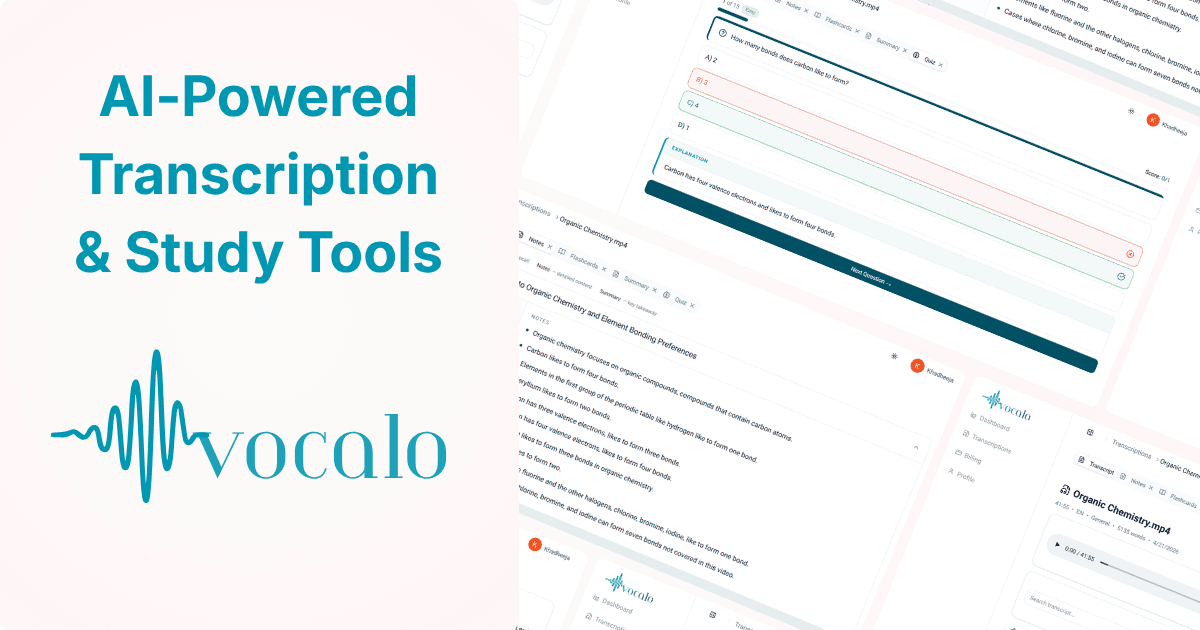
Six months later, I have something, that I can show — Vocalo, an AI-powered tool that turns lecture recordings into transcripts, summaries, flashcards, and practice questions. But the most valuable thing that came out of those six months wasn't the software. It was a much clearer picture of who actually needs this, and why.
Why I Kept Going After the Competition
The competition ended. The deadline passed. Vocalo wasn't polished enough to put in front of real users.
The easy thing would have been to shelve it. A lot of sprint projects end exactly that way — not because the idea was bad, but because the momentum runs out once the external pressure is gone.
I kept going partly because I believed in the problem, and partly because I'd already learned enough to know what needed fixing. The core idea worked. It just needed more time and honestly more talking to the kinds of students who would actually use it.
So that's what I did. Slowly, alongside everything else.
The Students I Built This For
When I started, I had a vague idea of my audience: "students who want better notes." That's almost everyone. It's also no one in particular.
As I talked to more people, four groups kept coming up — and they're the ones Vocalo was really built for.
Students with disabilities who find note-taking physically or cognitively exhausting. Sitting in a lecture and trying to write everything down while processing what's being said is genuinely hard. For students with dyslexia, ADHD, hearing impairments, or motor difficulties, it can make lectures an exercise in stress rather than learning. Having an accurate transcript removes that friction entirely.
Part-time students who miss class. A lot of students aren't full-time. They're working jobs, caring for family members, managing health issues. They miss lectures — not because they don't care, but because life happens. When you miss a class, you're usually dependent on a classmate's notes, which may be incomplete, or a recording you have no easy way to navigate.
International students still getting comfortable with the language. Following a fast-speaking lecturer in your second or third language is genuinely hard. You might understand 80% in the moment, but that missing 20% is often exactly the technical term or key concept you needed. A searchable transcript you can re-read at your own pace changes that completely.
Students who just want complete, accurate notes. Some students simply have high standards for their own study materials. They don't want to piece together handwritten notes and a half-remembered recording at 11pm before an exam. They want the lecture, organized, ready to study from.
These aren't niche edge cases. They're a huge portion of the student population, and most tools aren't built with them specifically in mind.
What Vocalo Actually Does
You upload a lecture recording. Vocalo transcribes it, generates a summary, creates flashcards, and builds practice questions — all from the same audio file. Everything is searchable, so you can find that one thing your professor said without scrubbing through an hour of audio.
The hardest part to build honestly wasn't the transcription. It was pricing. Students are price-sensitive, and they should be. Vocalo has a free tier — 5 hours of transcription, no card required — because I wanted anyone to be able to try it without a commitment. If you need more, there's a Pro plan with 40 hours and a Premium plan with 100 hours. But convincing someone to get that far — to even try the free version — is a different kind of problem than writing code. I'm still figuring that part out.
Where Vocalo Is Now
Vocalo is in early access. There's a free tier — 5 hours, no card required — so you can try it before deciding anything. If you record lectures regularly, that's enough to know whether it works for you.
It's especially useful if you miss classes regularly, if English isn't your first language, if traditional note-taking is difficult for you, or if you just want your study materials to actually be organized when exam season hits.
Built by a founder who was also once a student who missed too many lectures.